Showing posts with label hard cider. Show all posts

Monday, October 13, 2014

Alternative Clarifiers (Fining Agents)

Fining Agents (Clarifiers)

Here is a short list of some of the fining agents you can use in cider making.  The yellow highlighted option (Bentonite) is what I used on our first try.  I prefer non-animal source clarifiers, which is why I won't choose Gelatin, Chitosan or Isinglass.

From all I've read, the most successful clarifying process combines negatively and positively charged clarifiers.  So our first step was to use Bentonite and I believe we'll follow up with Sparkolloid afterwards.


Pectinase- This is more of a pressing aid than a clarifier that needs to be added to the mash when the apples are being ground, prior to pressing, and held at 30 °C for 15min to 2 hrs. Do not add at the same time with another enzyme or clarifier, as it will be absorbed or inactivated.  (We used pectinase immediately after pressing)

Bentonite (- charge): attracts positive charged yeasts and proteins. The lees are fluffy and not as compact. Low potential to over fine. Does not usually affect color or tannin, but can affect overall product quality.

The term Bentonite was first used for a clay found in about 1890 in upper cretaceous tuff near Fort Benton, Wyoming. This particular type of Bentonite is known for an unusually high electrostatic charge along with hydrogen bonding, causing suspended particles to cling to it as it settles to the bottom of the container.

Gelatin (+ charge): attracts negative charged bacteria and polyphenols. Lees aren't as fluffy as bentonite. Can easily over fine. Will strip color and tannin. Less likely to affect overall quality compared to bentonite.  (I would not use this simply because it is animal-derived.)

Chitin or "chitosan" (+ charge): a flocculating agent, very compact lees, good product quality. Does not remove color or flavor, more expensive than other finings, potential allergen from crustacean (made from ground crab shells).  (I would never use this simply because of its allergen potential.)

Kieselsol (- charge): a good flocculating agent if used with gelatin or chitin, medium priced, made from silica.

Isinglass (+ charge): very gentle fining, not very efficient, medium price point, potential allergen from fish (made from fish bladders).  (I would never use this simply because of its allergen potential.)

Sparkolloid (+ charge):  a proprietary blend of polysaccharides and diatomaceous earth. (I plan to use this following my Bentonite clarification, because I've read that using a positive and negative charged clarifier yields the best, clearest result.)

Sparkolloid is a fining agent developed by Scott Laboratories for clarification. It is a blend of polysaccharides in a diatomaceous earth carrier and has a strong positive charge. Sparkolloid is one of the more benign fining materials, and when used in reasonable quantities, it seldom strips wine flavors or aromas.

It neutralizes the repelling charge of particulate matter allowing aggregation and formation of compact lees. It does not remove desirable color constituents. It is not a cold stabilizing, heat stabilizing or odor removing agent. 1 tsp. per gallon clarifies naturally by removing protein haze.

To prepare for adding, it is recommended to use distilled water distilled water. Bring 2 cups to boiling and stir in 1 tsp. per gallon of Sparkolloid. Stir frequently, maintain the mixture at about 180*F. Sparkolloid contains some filter aids that will not dissolve. These particles will be adequately distributed by constant stirring as it is being heated. Agitating the mixture constantly is important. When all the globulues of clarifier have gone into suspension and the mixture is smooth and creamy (about 15 minutes), Slowly stir the Hot Sparkolloid into the wine to be clarified. Sparkolloid produces very fine lees, and the lees settle out of the wine slowly. Consequently, this material should not be used less than 30 days before bottling time, or small amounts may precipitate later in the bottles. Many winemakers allow for an eight-week settling time just to be on the safe side.


Cider Making Assistant #2, Dusty.


Friday, September 19, 2014

Day 5 (Video Clip)

Day 5

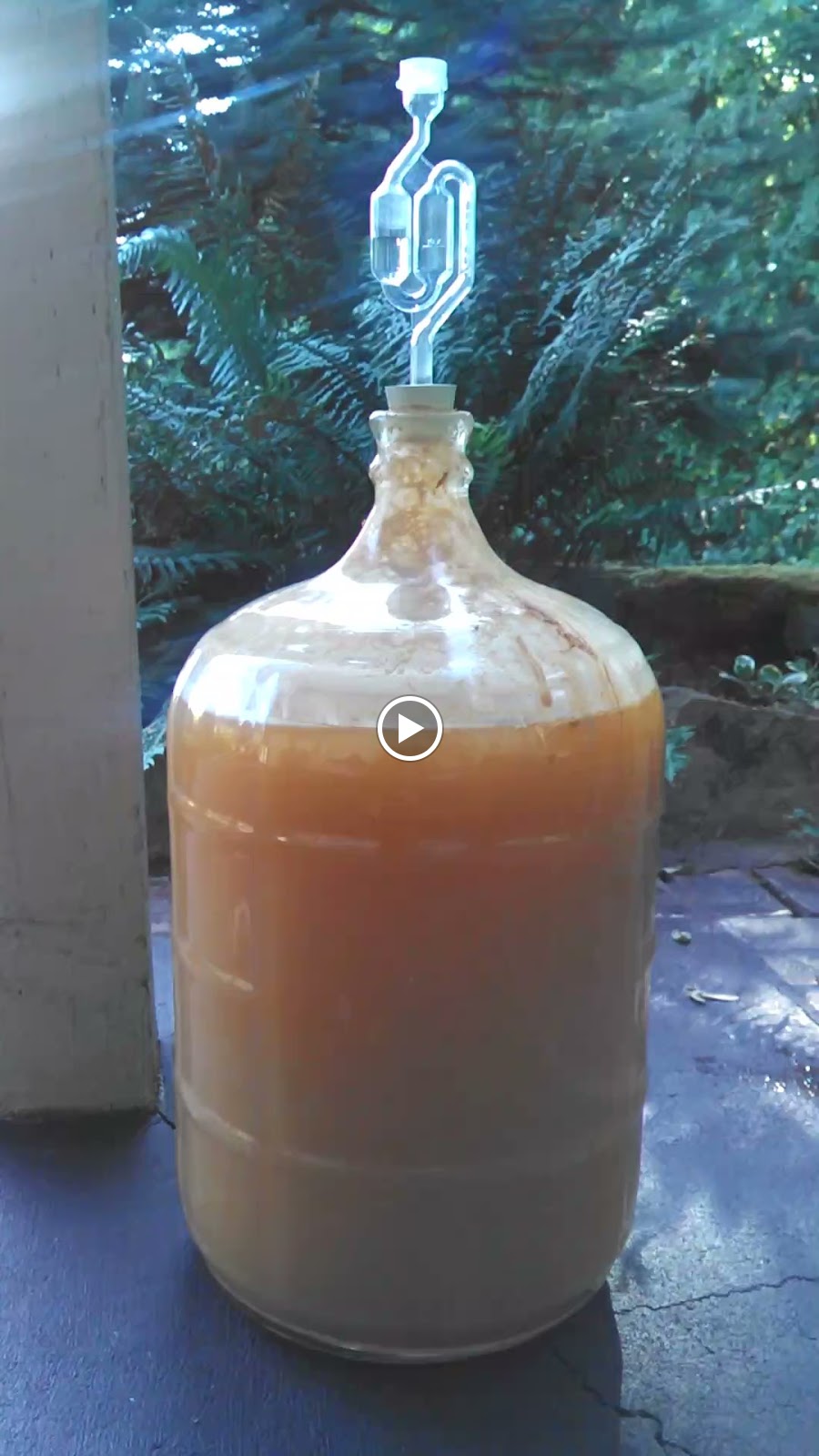
We installed the airlock this morning.  The little water column inside the airlock (left side) allows the gases to escape through the water and out of the perforated closure without allowing ambient air to come back inside the carboy.

You can see the process in this short video clip.


Thursday, September 18, 2014

Apple Varieties We Didn't Juice This Year

Not every year produces a bumper crop.

These are the varieties in my cider orchard that we didn't include in this year's juice pressing:

Calville Blanc (1598)

Planted in King Louis XIII garden at Orleans in 1627.  Originating in France/Germany around 1598 and grown for Louis XIII, Calville Blanc is higher in Vitamin C than an orange.  Sometimes referred to as the dessert apple of France because it holds up beautifully in baked goods.

I love the color and shape of this apple.  The color is a very pale spring green with a handsomely striking red blush.  The contrast is remarkable.  The shape is described as somewhat "oblate."  As you can see from the second photo taken of the bottom side of the Calville Blanc, it has very pointy indentations that gives it a flattened heart shape.


 Bottom of the Calville Blanc


Calville Blanc (left) compared to a Winter Banana (right)
It has an unusual shape in comparison to modern apples, as it is more oblate than round and has very distinctive ridges toward the bottom.  As you can see it is flatter, wider and shorter, common for the extremely old varieties.


Arkansas Black (1870)

Originated from a Winesap seedling in an orchard in Bentonville Arkansas in 1870.  A beautiful dark red apple, considered to be the best storage apple, keeping all winter.  A winesap is essential in cider.  Arkansas Black needs the Winter Banana for pollination.  This is a lovely deep burgundy apple, appearing to be nearly black in some light.


Ashmead's Kernel (1700s)

An ancient English variety about 300 years old, it was raised by Dr. Thomas Ashmead of Gloucester, England. The flavor has been described as "strong, sweet-sharp intense."  The apple's flavor is intensely strong when first picked, but sweetens and mellows greatly after several weeks in storage.  High sugar content, good acid balance. This variety is most often included in cider making.


Roxbury Russet (1640)

Presumably, the oldest apple variety of North America.  Found in Massachusetts in 1640, thought to have been planted by European immigrants.  Great cooking, cider & keeping apple.   Sugar content is very high (12.87%).  Roxbury Russet is a large apple no longer found on the commercial market.  An excellent keeper until April or May.  A delicious apple for cider.

Very similar to the Golden Russet, although older and perhaps just a little sweeter.

Day 4

Day 4


Doesn't look much different, but I can see that fermentation has slowed.


Tuesday, September 16, 2014

Day 2

Day 2


It looks like our fermentation process is active enough to have caused a little eruption.


I've been advised to loosen up the elastic band.  So that is what we've done this evening.  Once the fermentation stops/slows, we'll drain off the sediment.

Monday, September 15, 2014

Pressing Day

Pressing Day 


Fresh juice from Golden Russets, Esopus Spitzenberg, Belle de Boskoop, Winter Banana and Hudson's Golden Gem.

Immediately after pressing, the juice was golder in color and definitely not as clear.  We added Campden tablets, (sodium metabisulfite) to kill the natural yeast and it wasn't long before you could see the sediments falling to the bottom.  The next day, we had this lovely golden clear cider.  You can see a faint line where the juice looks clearer on top.

Tomorrow, we'll add the yeast & sugar.


25 Years in the Making


 25 Years in the Making


About 25 years ago, I read an article in the Better Homes & Gardens magazine about a man whose mission it was to preserve heirloom apples for their history and taste.  I carefully tore that article from the magazine and placed it in my wish file for for the day when I would have enough land to plant my own heirloom apple orchard.  I dreamed I would call this gentleman for advice and follow his legacy.

Many years passed until I finally had the land and desire to to put down roots to realize the fruit from this labor.  I had studied his recommendations on the best combination of apples for cider.  As planned, I hunted down the man from the Better Homes & Gardens article and found a phone number to call.  I was one year too late, as the gentleman had passed away.  His family advised me that they had sold all his root stock to a new business that would be carrying on his legacy called "Trees of Antiquity."

The rest is history.  I found 9 varieties of heirloom apples from Trees of Antiquities a decade ago that just yielded their first cider pressing.