Showing posts with label apple cider. Show all posts

Monday, October 6, 2014

Arkansas Black


Arkansas Black (1870)

This tree originated from a Winesap seedling in an orchard in Bentonville Arkansas in 1870.  A winesap is essential in cider because it adds that bit of tannin, like what you taste in red wine.  It's that taste that leaves your mouth feeling a bit dry.

This is a very hard apple, which is probably why it can be stored all winter long.   It is a brilliant deep red that polishes up beautifully owing to its even, smooth skin.  The flesh is creamy white.

First you taste sweet, followed by tannins. 


Arkansas Black on the left next to the Roxbury Russet (greenish apples) and the Ashmead's Kernel (golden with an orange blush).


Saturday, October 4, 2014

Time to Decant

Step 1 in Clarifying

Two weeks have passed and rather than take daily photos of bubbling cider fermenting, I thought we would allow it a little privacy to mature and tell you about the next steps we took toward clarifying the cider.

Two days ago, Bernie & Elaine came over to decant the 5 gallon carboy into a different, freshly sterilized carboy.  This allowed us to throw away the sediment which could lend bitter notes and unpleasantness to the cider (left carboy). 


After decanting the original carboy, we added 1/2 teaspoon/gallon (2.5 teaspoons) of pectinase to help the sediment drop.  We also topped off the carboy with fresh pressed cider that had been treated with a campden tablet.

Step 2 in Clarifying

Today (October 4) we decanted the carboy for a second time.  This is the carboy before its second decanting.  While it is a lovely color, it is still very sediment-heavy.


 So, we siphoned the cider into a clean carboy.


And waited for the second carboy to fill.


After decanting the cider, we decided to sweeten it with honey from Bernie's own carefully tended beehives (Pete's Mountain Honey).  We're aiming for our cider to be 4% sweetened by natural honey.


As we were adding the honey, the fermentation process went wild and bubbling in the airlock resumed at an even faster pace.  You can see the process starting with white frothy bubbles in the carboy below.


In retrospect, I wish I had waited a couple of weeks to make the cider, because today's freshly picked apples had a sweeter, juicier quality than just two weeks ago.

Esopus Spitzenberg

I'm with Thomas Jefferson.  This is one of my favorite fresh off the tree eating apples.  It is deliciously sweet with a nice hard flesh that is beautiful golden yellow inside.  We harvested some from the tree top today and they were sun-warmed and very sweet.

In my orchard, the pollinators for this apple are the Winter Banana and the Calville Blanc.


Golden Russet

Even sweeter this week, the Golden Russet is probably the most flavorful apple in our orchard.


Monday, September 15, 2014

First 5 Gallons

The First Five Gallons Take the Longest

We needed to devise a system that actually produced juice.  

While our little press looked authentically romantic and colonial, its grinder was seriously deficient.  Perhaps if the apples had been very soft and juicy, it may have worked; but when it came to juicing, modern technology saved the day.

At first we tried setting up our Champion Juicer, which produces a no-waste juice that is clearly nutrition packed, but also difficult to filter.

Then we happened upon the perfect solution.  We used the coarse shredding blade of the Cuisinart food processor to shred apples that had been cored and segmented, and then pressed them with the cider press.


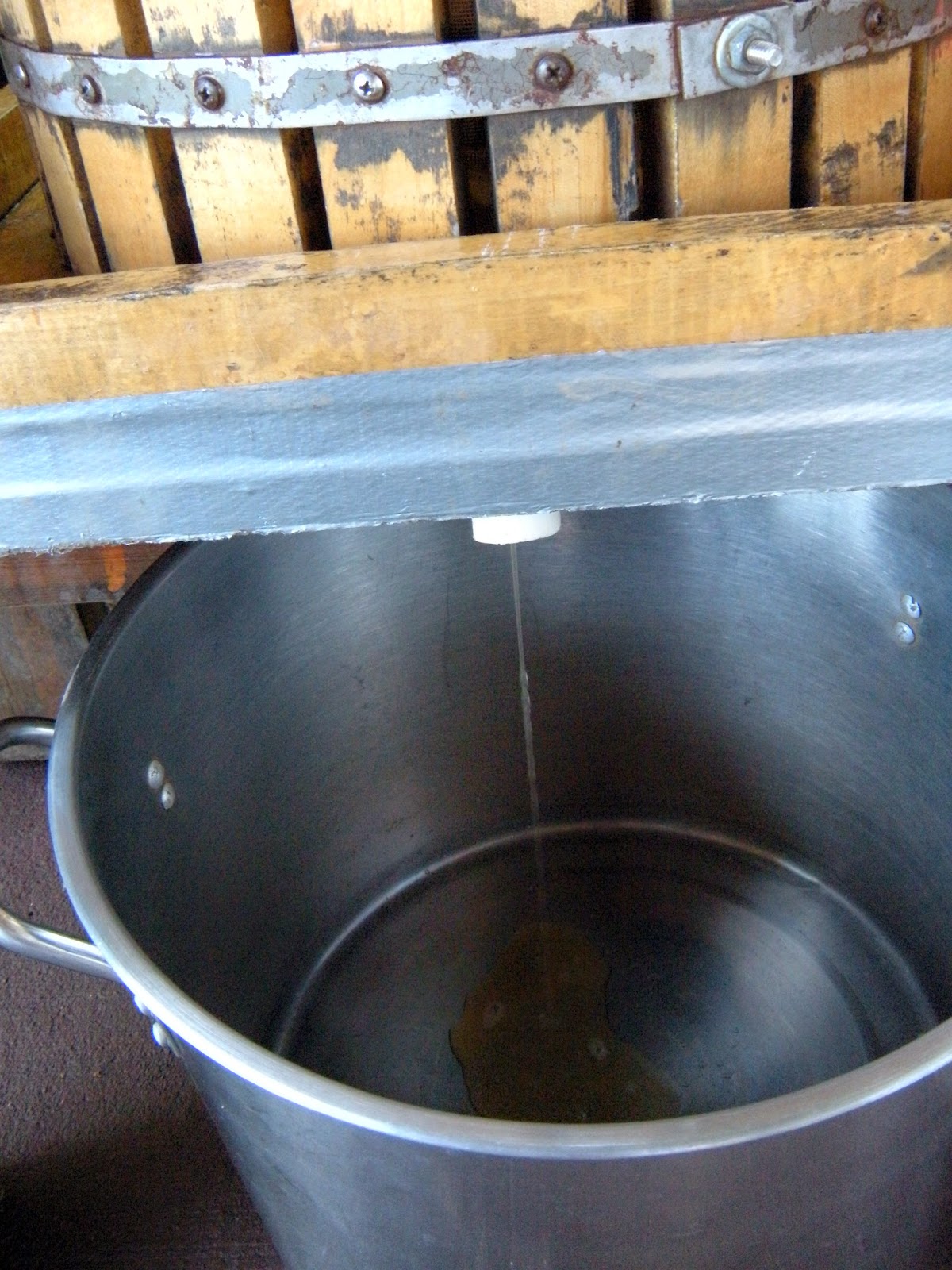
We were so thrilled by the first tiny trickle.


After 10 hours of work on Saturday and 7 hours on Sunday, we yielded approximately 13 gallons of apple juice.  
Our friend pressed 5 gallons of grape juice as well. 

Here is the result of the first 5 gallons before the sediment settled out. 


This is how it looked later in the day.


This is two of us at the end of the second day after 17 hours of pressing.  We're exhausted.


Cider Apples

Hudson's Golden Gem (1931)


Found in a fenceline thicket in Tangent Oregon in 1931, Hudson's Golden Gem is the shape of a Bosc pear and has a sweet, pear-like flavor.  It was originally marketed in the 1930s as a pear!


I'm a fan of russets and Hudson's Golden Gem is a fine quality russet apple, perfect  for making cider.

25 Years in the Making


 25 Years in the Making


About 25 years ago, I read an article in the Better Homes & Gardens magazine about a man whose mission it was to preserve heirloom apples for their history and taste.  I carefully tore that article from the magazine and placed it in my wish file for for the day when I would have enough land to plant my own heirloom apple orchard.  I dreamed I would call this gentleman for advice and follow his legacy.

Many years passed until I finally had the land and desire to to put down roots to realize the fruit from this labor.  I had studied his recommendations on the best combination of apples for cider.  As planned, I hunted down the man from the Better Homes & Gardens article and found a phone number to call.  I was one year too late, as the gentleman had passed away.  His family advised me that they had sold all his root stock to a new business that would be carrying on his legacy called "Trees of Antiquity."

The rest is history.  I found 9 varieties of heirloom apples from Trees of Antiquities a decade ago that just yielded their first cider pressing.