Monday, September 15, 2014

Day 1 (Post Pressing)

Day 1


About 1 inch of foam on top of the cider.  Fermentation has begun.


So How High Will It (You) Get?

Hygrometer


I was pretty tired by the end of day two picking, chopping, shredding, pressing, pouring, repeat.

So doing the math for cider chemistry at the end of the day was a little taxing.  We used a hygrometer to determine the specific gravity of the juice to measure the sugar content.  A formula provided by our local home brew/wine making supply helped us to determine how much sugar to add to reach the alcohol content of our choosing.

My friend, Elaine, thought that one should get something out of all that hard work and not leave the alcohol content at a low 4-5% like simple beer.  Agreed.  We decided to shoot for 12%.

After adding the sugar, we hadn't adequately dispersed it through the heavy carboy, so we added more sugar when the hygrometer reading was still a little low.  After everything settled out, we realized that our alcohol content may be closer to 14%.  Most definitely not a lowly 4% beer.


Our friends pressed a batch of grapes to create this lovely pinkish grape juice on the left.


First 5 Gallons

The First Five Gallons Take the Longest

We needed to devise a system that actually produced juice.  

While our little press looked authentically romantic and colonial, its grinder was seriously deficient.  Perhaps if the apples had been very soft and juicy, it may have worked; but when it came to juicing, modern technology saved the day.

At first we tried setting up our Champion Juicer, which produces a no-waste juice that is clearly nutrition packed, but also difficult to filter.

Then we happened upon the perfect solution.  We used the coarse shredding blade of the Cuisinart food processor to shred apples that had been cored and segmented, and then pressed them with the cider press.


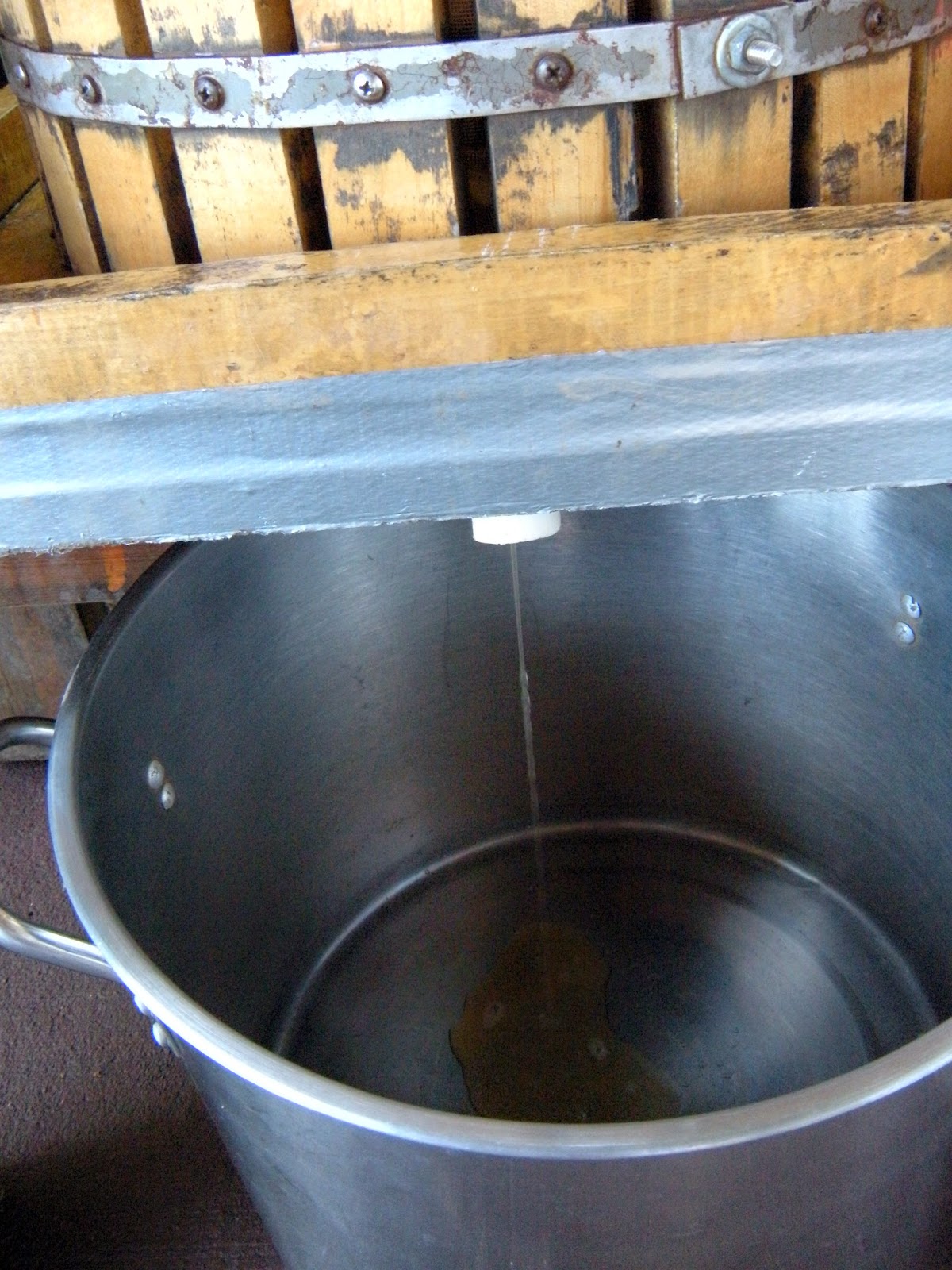
We were so thrilled by the first tiny trickle.


After 10 hours of work on Saturday and 7 hours on Sunday, we yielded approximately 13 gallons of apple juice.  
Our friend pressed 5 gallons of grape juice as well. 

Here is the result of the first 5 gallons before the sediment settled out. 


This is how it looked later in the day.


This is two of us at the end of the second day after 17 hours of pressing.  We're exhausted.


Pressing Day

Pressing Day 


Fresh juice from Golden Russets, Esopus Spitzenberg, Belle de Boskoop, Winter Banana and Hudson's Golden Gem.

Immediately after pressing, the juice was golder in color and definitely not as clear.  We added Campden tablets, (sodium metabisulfite) to kill the natural yeast and it wasn't long before you could see the sediments falling to the bottom.  The next day, we had this lovely golden clear cider.  You can see a faint line where the juice looks clearer on top.

Tomorrow, we'll add the yeast & sugar.


Cider Apples

  The Winter Banana (1876)

A showy apple - pale, thin waxy yellow skin with pink blush.


We found this mild tasting apple very hard but juicy.  I chose to plant it because many people talked about its distinctive banana aftertaste; but honestly, I couldn't discern it.

Although our box of Winter Bananas looked a little spotted, there was no rot inside.  The spots affected only the outside.

The Winter Banana serves as the pollinator for my Esopus Spitzenberg and also the Arkansas Black.


Cider Apples

The Belle de Boskoop (1856)


I confess that I only planted this apple because it was my German mother's favorite apple as a child.  She said it was the first piece of fruit she tasted after the war and that memory gave her so much pleasure that I thought she should enjoy it again.

It has turned out to be a prolific producer of large, tart, greenish apples that have a nice sweet finish.

Belle de Boskoop (1856)

Cider Apples

The Golden Russet


I didn't intend to buy the Golden Russet when I planned my cider orchard.  I was looking for historically significant, really special apples and this one just seemed...well, a little ordinary.  But I was persuaded by an apple connoisseur who said that the Golden Russet was quite possibly the greatest American cider apple.

I would have to say that deferring to the expert really paid off.  Of all the apples we pressed, this was the juiciest, hardiest, most disease-resistant apple in the orchard.  It produced a lovely tart & sweet juice.


Here's a review by a very serious apple lover:  Golden Russet Review.

What's a Russet?

See how this apple's skin looks a little brown...like a Russet potato some might say.  Russets sometimes have a brown, splotchy or leathery skin.  In Shakespeare's time, this type of apple was referred to as a "Leatherskin."  When you bite into a Russet apple, you'll hear a loud crack and experience a burst of flavor.  While not as picturesque as apples cultivated for today's aesthetics, this heirloom variety typically produces the highest sugar content and varied flavor profile.

The Golden Russet dates back to the 1700s from New York.

So while I may originally have thought this one to be ordinary, I couldn't have been more wrong.

Cider Apples

The Esopus Spitzenberg (1700's)


Rumored to be Thomas Jefferson's favorite eating apple from Monticello.  Jefferson operated Monticello as a working farm, growing apples for commerce.  The Esopus Spitzenberg, introduced sometime in the 1700s by an early Dutch settler for whom it was named, was grown in a settlement on the Hudson River in New York, called Esopus.  This was the apple Jefferson supposedly kept for himself.

An excellent cider apple that has a very sharp flavor with enough acid to balance the sweetness, the Esopus Spitzenberg is susceptible to many diseases afflicting heirloom apples. 

I was fortunate that mine turned out only partially afflicted despite their relative neglect over the past few years.  Our tree was very bountiful this year.

The E. Spitzenberg is a lovely green with a red blush and a buttery yellow flesh.

This variety is exceptionally high in malic acid, although  mild, it is good for digestion.  A nice eating apple, but an even nicer cider apple.


Cider Apples

Hudson's Golden Gem (1931)


Found in a fenceline thicket in Tangent Oregon in 1931, Hudson's Golden Gem is the shape of a Bosc pear and has a sweet, pear-like flavor.  It was originally marketed in the 1930s as a pear!


I'm a fan of russets and Hudson's Golden Gem is a fine quality russet apple, perfect  for making cider.

25 Years in the Making


 25 Years in the Making


About 25 years ago, I read an article in the Better Homes & Gardens magazine about a man whose mission it was to preserve heirloom apples for their history and taste.  I carefully tore that article from the magazine and placed it in my wish file for for the day when I would have enough land to plant my own heirloom apple orchard.  I dreamed I would call this gentleman for advice and follow his legacy.

Many years passed until I finally had the land and desire to to put down roots to realize the fruit from this labor.  I had studied his recommendations on the best combination of apples for cider.  As planned, I hunted down the man from the Better Homes & Gardens article and found a phone number to call.  I was one year too late, as the gentleman had passed away.  His family advised me that they had sold all his root stock to a new business that would be carrying on his legacy called "Trees of Antiquity."

The rest is history.  I found 9 varieties of heirloom apples from Trees of Antiquities a decade ago that just yielded their first cider pressing.